

You clamp your jaw during a difficult call.
You notice it only when someone mentions it — or when your jaw aches at 3pm.
A 2026 study of 222 temporomandibular disorder patients found that awake bruxism — clenching during waking hours — was significantly associated with depression, anxiety, and stress, with medium-to-large effect sizes.
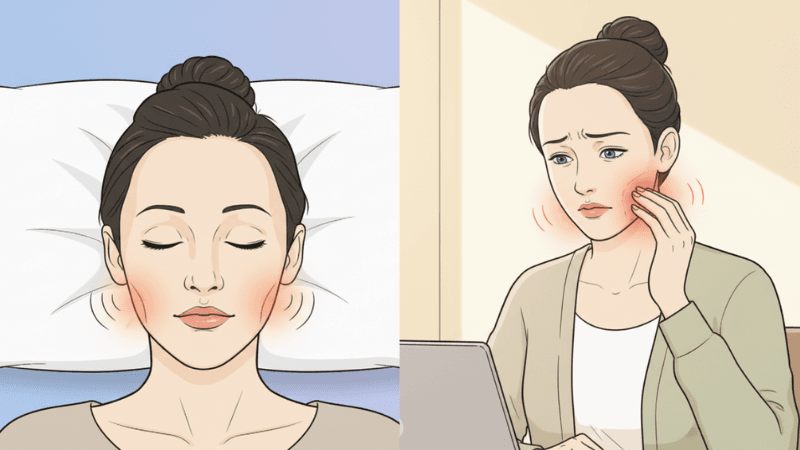
Sleep bruxism — the grinding at night — showed no significant association with any psychological measure.
Same jaw. Completely different drivers. Completely different treatments.
The night guard addresses one. Stress regulation addresses the other.
A 34-year-old marketing director in Dublin had worn a night guard for two years.
Her dentist had correctly identified bruxism. He’d addressed the grinding at night.
Her jaw pain was worst by 2pm — not in the morning.
She clenched during every difficult meeting, every deadline call, every unread email that landed badly.
The night guard was the right intervention for the wrong half of her problem.
The 2026 study would have placed her awake clenching in the category with the highest psychological burden — and confirmed that stress was its only independent predictor.
If your jaw pain builds through the workday — peaking in the afternoon, worse on high-demand days, easing on weekends — you have awake bruxism driven by accumulated stress load, not a structural jaw problem.
The 2026 study confirmed it: perceived stress was the only variable independently associated with awake bruxism after controlling for age, sex, pain intensity, symptom duration, depression, and anxiety.
The jaw is where the stress lands. The stress is the treatment target.
A 2026 retrospective study published in the Journal of Oral & Facial Pain and Headache reviewed 222 TMD patients.
Awake bruxism was significantly associated with all three psychological measures:
Depression (PHQ-9): Cramér’s V = 0.387, p < 0.001
Anxiety (GAD-7): Cramér’s V = 0.423, p < 0.001
Perceived stress (PSS-10): Cramér’s V = 0.425, p < 0.001
Sleep bruxism showed no significant association with any of the three.
In multivariable logistic regression — controlling for age, sex, pain intensity, symptom duration, and all three psychological measures simultaneously — perceived stress was the only independent predictor of awake bruxism (OR = 1.15, 95% CI: 1.09–1.22, p < 0.001).
Patients with chronic symptoms had significantly higher psychological burden than those with acute symptoms across all three measures (all p < 0.001, effect sizes 0.36–0.46).
[Source: Limrachtamorn T. Temporomandibular disorders in a tertiary clinic: associations with pain, chronicity, sleep versus awake bruxism, and psychological factors. J Oral Facial Pain Headache. 2026;40(1):106–118. PMID: 41607328 → https://pubmed.ncbi.nlm.nih.gov/41607328/]
WHAT EVERYONE TRIES:
Night guards / dental splints / occlusal adjustment — for all jaw clenching regardless of when it occurs
WHY IT FAILS FOR DAYTIME CLENCHING:
Night guards address nocturnal grinding — a neurophysiological behaviour regulated by sleep architecture and CNS arousal. Awake bruxism is a different behaviour with a different driver. The study confirmed perceived stress is its only independent predictor. A night guard worn at 2pm during a deadline call does nothing for the stress loading the jaw muscles from the inside.
WHAT WORKS:
Identify the stress as the driver → address the nervous system pattern maintaining the jaw tension → build awareness of jaw position throughout the workday — in that order
Why Awake and Sleep Bruxism Are Two Different Problems
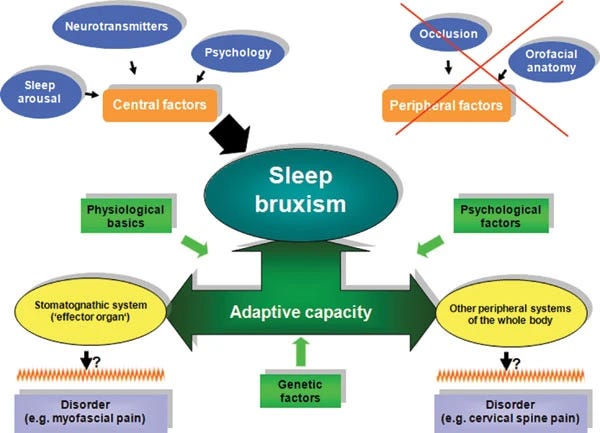
The study’s clearest finding is the one least discussed in dental practice.
Awake bruxism: driven by stress, anxiety, and depression. The jaw clenches as part of the sympathetic nervous system’s arousal response. Every stressful stimulus — email, call, decision — can trigger it unconsciously.
Sleep bruxism: driven by CNS arousal mechanisms during sleep, serotonergic and GABAergic modulation, and links to obstructive sleep apnea. Psychological factors showed no significant association in the study.
Treating both with the same dental intervention is like treating a tension headache and a migraine with the same pill because both involve head pain. The mechanism is different. The treatment must match it.
The Chronic Symptom Warning
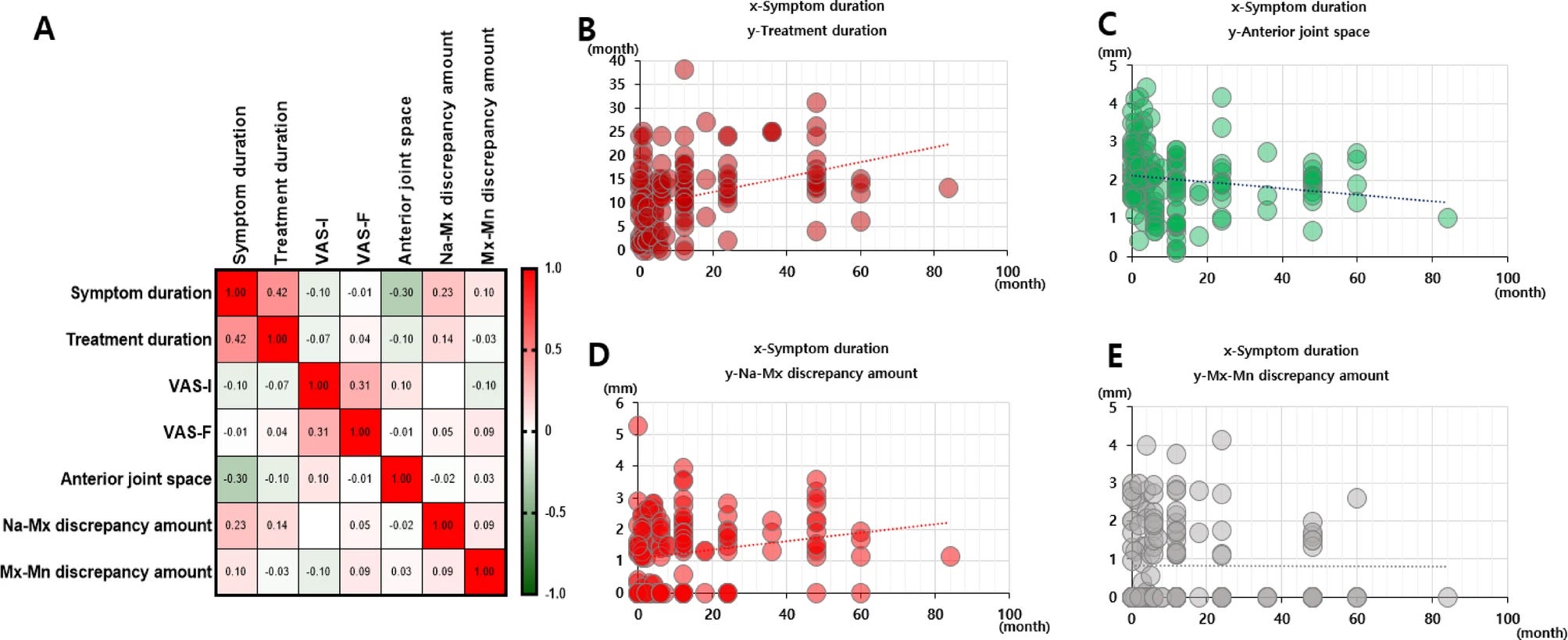
The study found that chronic symptoms — lasting more than 3 months — were associated with significantly higher depression, anxiety, and stress than acute symptoms, with effect sizes of 0.36–0.46.
This isn’t just correlation. It’s a warning about untreated awake bruxism.
Every month of unaddressed stress-driven jaw clenching deepens the psychological load — which drives more clenching, more pain, more avoidance, more anxiety about the pain.
The loop runs: stress → clenching → jaw pain → more stress → more clenching.
Breaking it requires entering the loop at the stress end — not the jaw end.
The study shows stress drives the jaw clenching but doesn’t cover what drives the stress at the biological level. Gut microbiome quality is one factor that may influence baseline stress regulation — gut bacteria produce neurotransmitters including serotonin and GABA that affect mood and the stress response. Coach Dylan covered the specific research on this in You’re not fat. Your gut is starving, including a 2021 Stanford trial and what it found about the gut-mood connection that surprised the researchers.
Which of these matches your situation:
→ Jaw tight by mid-afternoon — fine in the morning
→ Jaw pain worse on high-demand days — better on rest days
→ Notice clenching only when someone points it out
→ Teeth don’t hurt — jaw muscles and temples do
→ Night guard prescribed — jaw pain still worst during the day
Reply with whichever one matches.
If your pattern is on that list — I want to look at the full jaw-stress-posture picture with you. Dylan reviews every reply personally. Roughly 3 in 10 applications are accepted.
Not ready? The full protocol is below.
Here’s the exact awake bruxism stress reset — jaw position retraining, stress-driven clenching interruption, masseter release, and the nervous system protocol that addresses the driver the study confirmed.
The Awake Bruxism Reset:
Awareness → Position → Release → Regulate
Awake bruxism is unconscious. You don’t decide to clench. Your nervous system does it automatically under stress load — the same way your shoulders rise toward your ears during a tense call.
The protocol builds conscious interruption of an unconscious pattern — repeatedly — until the interruption becomes the automatic response instead of the clench.
This takes weeks, not sessions. The study confirmed perceived stress as the independent predictor. The protocol addresses both the jaw position and the stress load maintaining it.
Step 1: Jaw Resting Position Awareness
(Every transition — sitting down, standing up, starting a new task)
