
Side sleeping isn't fixing your back at night

Your physio told you to sleep on your side.
You do. Your back still wakes you at 2am.
A 2024 cross-sectional study of 375 chronic low back pain patients found that 87% already slept on their side — and they had the highest disability scores and the most leg pain of all three sleeping positions studied.
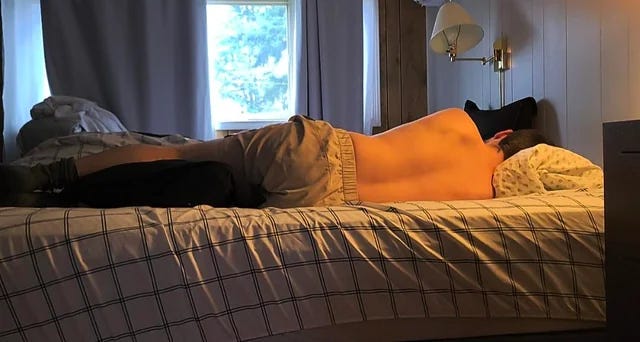
Side sleeping is not the wrong advice. It’s incomplete advice.
The position matters. What you do inside the position matters more.
If your back wakes you at night despite sleeping on your side — the position is correct but the load inside the position isn’t managed.
Side sleeping puts lateral pressure on the hip, rotates the pelvis, and creates a torsional load on the lumbar spine when the knees aren’t supported. The spine doesn’t rest. It braces for 7 hours.
The 2024 study found that lying down relieved pain for 59% of patients — but only when they found the right position. Most hadn’t.
A 2024 cross-sectional study published in Cureus assessed 375 consecutive chronic low back pain patients at a specialist spine clinic.
92% reported difficulty sleeping or getting up due to back pain.
77% had sleep disturbed by back pain at night.
76% actively avoided at least one sleeping position due to pain.
87% slept on their side — and this group had significantly higher Oswestry Disability Index scores and more leg pain than supine or prone sleepers (p < 0.001).
59% reported that lying down relieved their back pain — but only when the right position was found.
[Source: Ylinen J et al. Preferences and Avoidance of Sleeping Positions Among Patients With Chronic Low Back Pain. Cureus. 2024;16(5):e59772. PMID: 38846227 → https://pubmed.ncbi.nlm.nih.gov/38846227/]
WHAT EVERYONE TRIES:
Switching to side sleeping on generic advice — without addressing what happens inside the position
WHY IT FAILS:
87% of the study’s most disabled patients already slept on their side. Side sleeping without knee support allows the pelvis to rotate forward, increases torsional load on the lumbar spine, and puts sustained lateral pressure on the hip — which irritates the lower back through the night regardless of the starting position.
WHAT WORKS:
Manage the load inside the side-lying position — knee pillow, hip alignment, lumbar support — so the spine rests instead of bracing for 7 hours
Why the Prone Position Is the Most Avoided
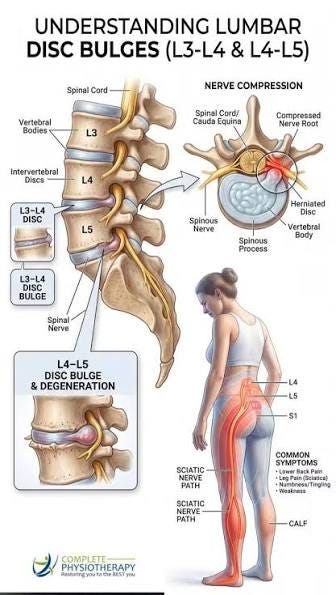
42% of patients avoided the prone position entirely — the highest avoidance rate of any position.
The research explains why: face-down sleeping increases lumbar lordosis, loads the facet joints, and causes the ligamentum flavum to buckle — confirmed on MRI in patients with and without radiculopathy.
The prone position also forces the neck into sustained rotation for hours — loading the cervical spine simultaneously.
If you sleep prone and have lower back or neck pain — this is the first position to change. The structural case against it is the clearest in the literature.
Why the Supine Position Gets Dismissed Too Quickly
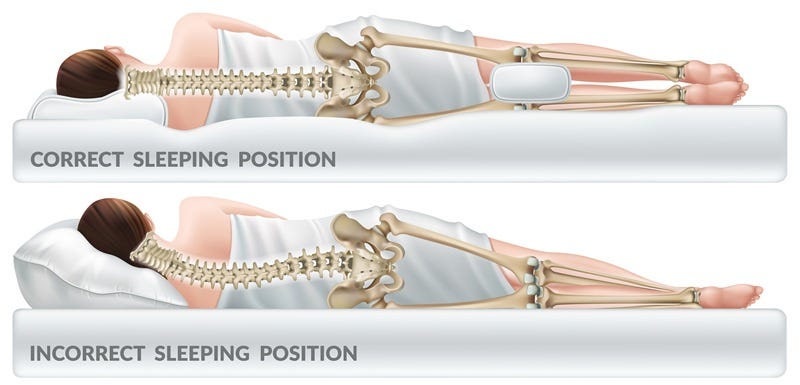
35% of patients avoided sleeping on their back — often because it had been recommended without the one modification that makes it work.
Supine sleeping without knee support increases lumbar lordosis — the same problem as prone, just less severe.
Supine sleeping with a pillow under the knees reduces lumbar lordosis, decompresses the facet joints, and allows the lumbar muscles to rest rather than brace.
The position that 35% avoided is the position that works best for most disc-related pain — when set up correctly.
Which of these matches your situation:
→ Side sleeper — back still wakes you at night
→ Avoid sleeping on your back — it makes the pain worse
→ Stomach sleeper — lower back pain worst in the morning
→ No comfortable position — you shift all night
→ Pain worse getting out of bed than during sleep itself
Reply with whichever one matches.
Here’s the exact sleep position setup — side-lying modification, supine setup, prone transition, and the morning getting-up sequence — that addresses what the 2024 study found 92% of back pain patients were getting wrong every night.
The Sleep Position Reset:
Side → Supine → Transition → Morning
Setup 1: Side-Lying — The Right Way
(Every night — for side sleepers)
Side sleeping is the most common position and the one most people do incorrectly.
The problem: without knee support, the top leg drops forward, the pelvis rotates, and the lumbar spine twists into a sustained torsional load for the entire night. The hip on the lower side takes all the body weight and irritates the lateral structures. The study found this group had the highest disability scores — not because side sleeping is wrong but because this is how most people do it.
